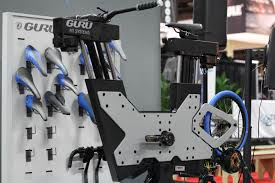
Retul has designed the most advanced new bike buying software in the world. It allows users to shop for new bikes and components based on the Retul Zin measurements established during Fitting.
Check it out:
Professional Bicycle Fitting Precautions
A Consumer’s Guide
An increasing number of bicycle dealers are now offering “professional fit” services”, and with fees ranging from $30-$400+, it is useful to have some facts before making an appointment — if an appointment is really what you need.
1. The majority of “Bicycle Fit Professionals” have attended a total of only 3-7 days training. Ask for credentials and references, and employ internet search-engines for unbiased data.
2. Systematic protocol is flawed by negating the diversity between cyclists. Humans are too unique and complex for patent assessments and and/or outcome data. If an adjustment causes discomfort, it is wrong for your body.
3. Video analysis is two-dimensional, regardless of how many cameras are used. 3D motion analysis is subject to LED placement variability. These tools are good at recording angles. Creating optimal fit is the responsibility of you and your technician.
4. Saddle Height is not static. To demonstrate, bend forward and try to touch the floor. Do it again. Try repeating the exercise when it is cold, hot, at the end of a hard ride, before an easy ride, etc. It will never be identical because our activities and climate are always changing. Remember this when prescribed the “magic number”.
5. Good bike fit does not hurt! If you continue to have pain anywhere that is not a function of fatigue, your fit can be improved
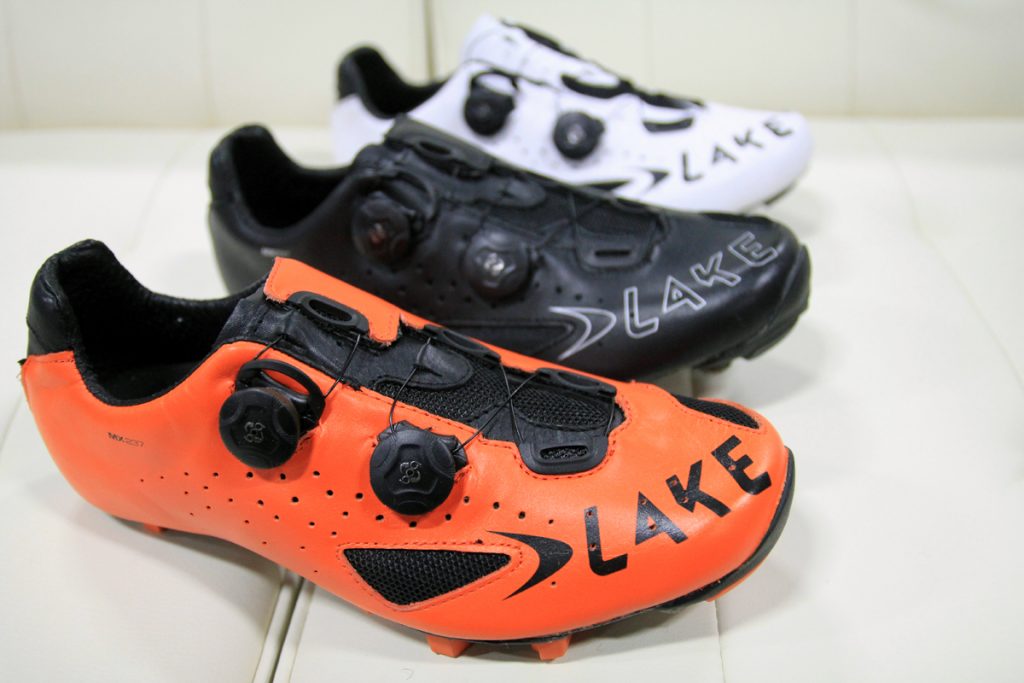
6. Shoes should be comfortable. Do not believe that they will “break-in”. They must not be loose, either. A good fit technician can modify shoe-fit with shoe-maker and podiatry tooling.
7. Assessment procedures based on physical therapy techniques are not reliable for outcome data. There is an inherent flaw to every test due to bone and ligament variability. So if you are told you have: “X”, “Y”, or “Z”, get it confirmed by a doctor before announcing it to the world.
8. It is not hard to find a comfortable saddle. It is very hard to find someone willing to put your bike on a stand and let you try a number of makes and models. Do not expect it to break-in. It is your fitter’s responsibility to determine proper sizing.
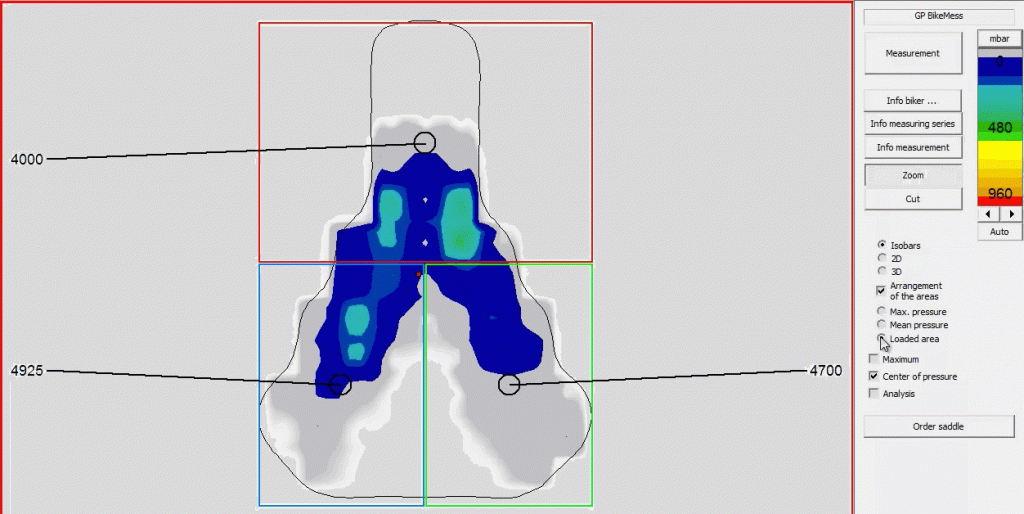
9. Sit-bone measurement devices have no utility when determining correct saddle-size. Saddle comfort is a product of pressure distribution and pelvic stability. The correct saddle for you will have a nose-width, taper, and terminal shape consistent with pubis, rami, tuberosities, and functional pelvic angle.
10. You are the true authority on bike fit for your body. The most accurate union for you and your bike resides inside YOU! The nervous system components, proprioception (feedback mechanism for body movement); vestibular sense (balance in relation to movement and gravity); and kinesthesia (joint position) are sufficient to the task, but are primarily “touchy-feely”. They are great at determining what is better and worse on a bike, but are unable to sample different options due to the nature of cycling.
Our problem is that riding a bicycle is unnatural. We were not intended to be stuck in a fixed, symmetrical position, making circles with our feet, suspended by saddle and handlebars. Our data for negotiating life is built from the knowledge, experience, and practice of events. Learning involves practice; practice increases knowledge, and time creates experience.
It is easy to buy a bike because your salesperson says it is “right for you”, but what does that really mean?
What it means to me, is that your bike can be positioned to provide a comfortable, fast ride for YOUR body.
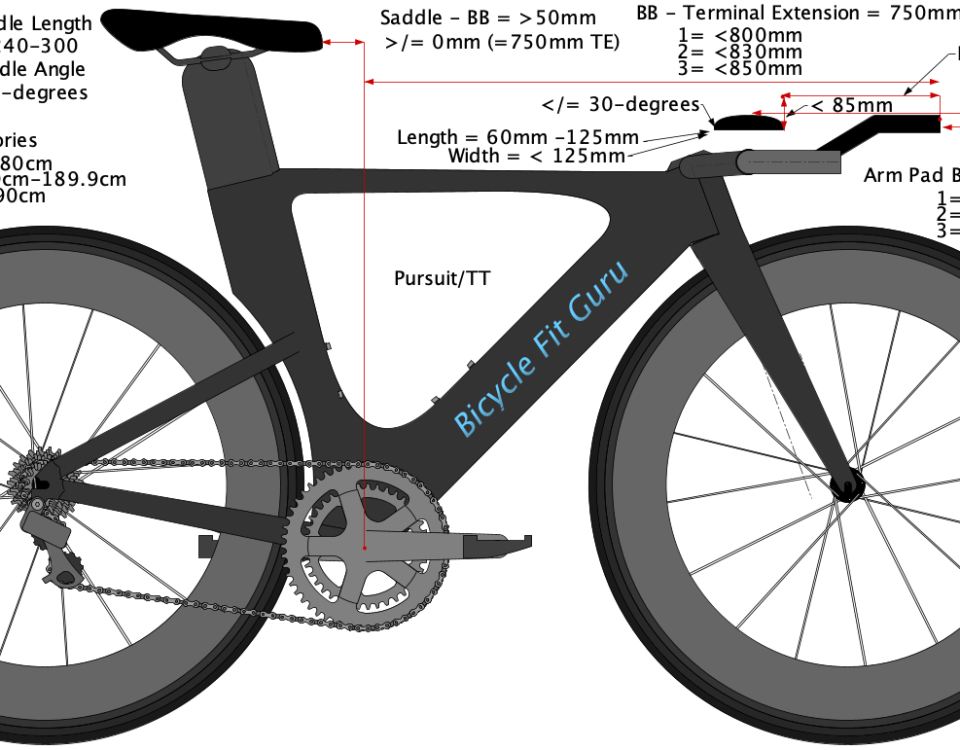
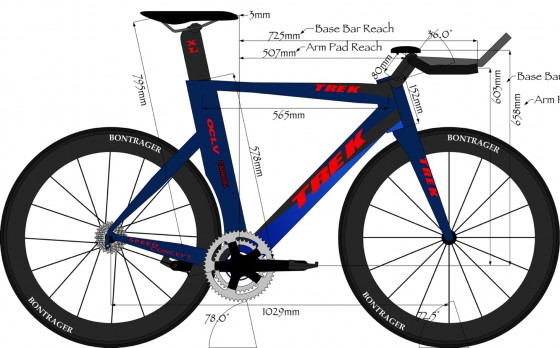
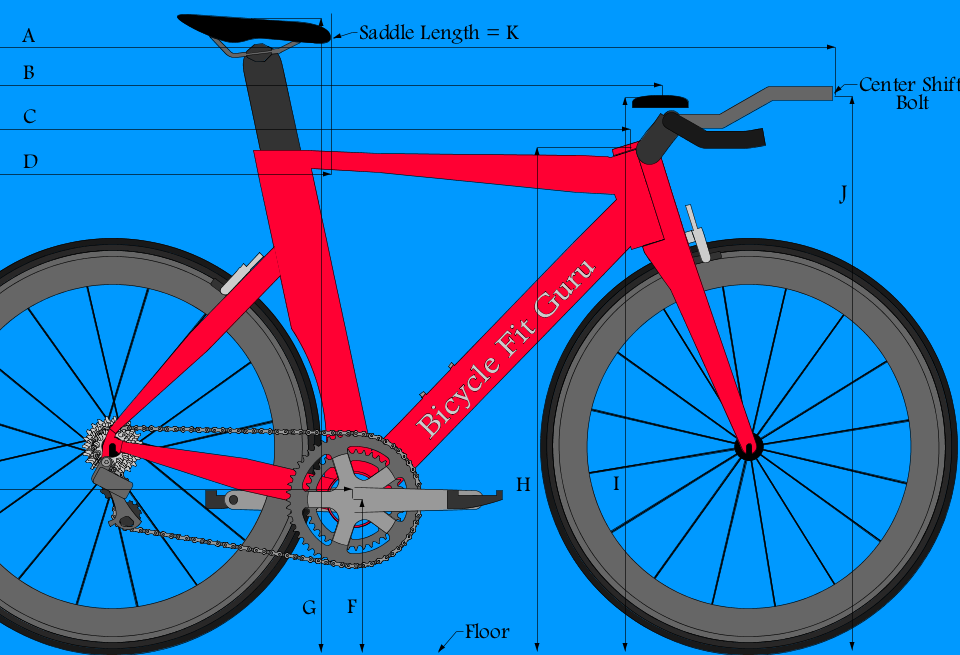
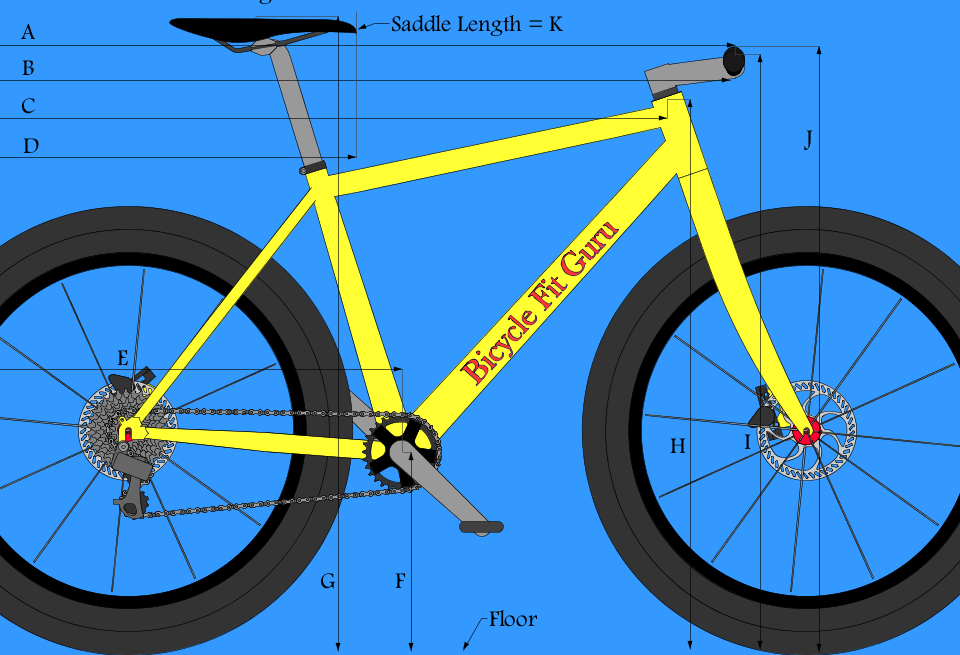
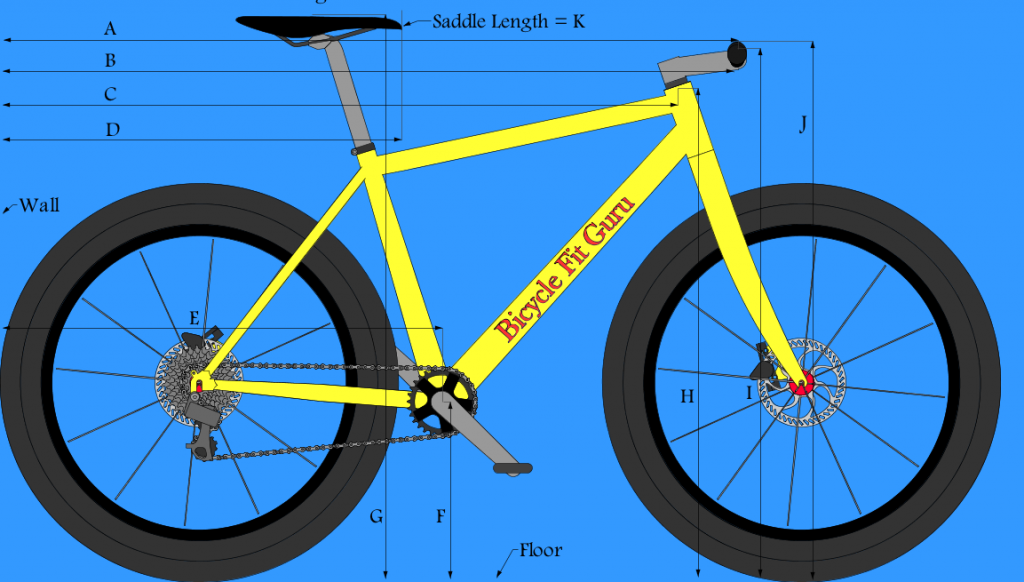
Every Triathlon Bike Manufacturer provides geometry specifics via the web, which vary between makers/models.
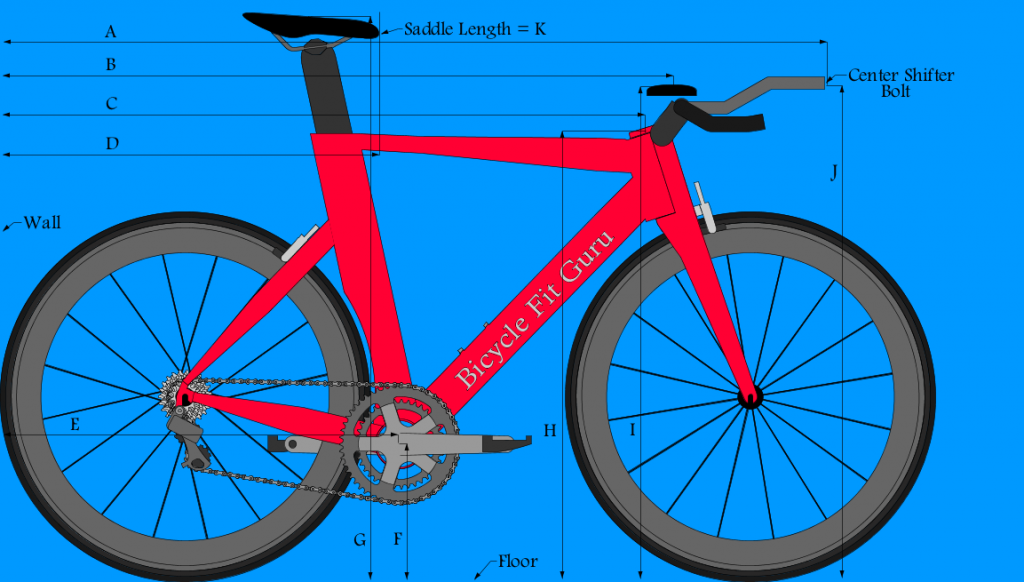
The term “Stack” referrs to the distance above the Bottom Bracket
The term “Reach” refers to the distance forward of the Bottom Bracket
The Bottom Bracket is measured from the center of the Crankset Bolt
In General:
1. “C” impacts Stack. Longer legs tend towards a “taller” bike, and vice-versa.
2. The measure “D” is more vertical on a bike than the measure “A”, and is therefore more important for determining Stack.
3. “E-F” aids to determine arm-pad Stack. Longer or short upper-arm = taller/lower pad position.
4. “B” impacts Reach, primarily, with “A” acting as a constraint with regard to knee/elbow clearance.
In Complex Terms:
Arm Pad “Stack” and “Reach” should match Torso Length and Effective Trunk Angle. Effective Trunk Angle accounts for Anatomical Variability (Upper/Lower Arm Length, Kyphosis, Lordosis, Scoliosis, Shoulder Roll, Injury, Prosthetic(s), etc.), betwen Hip Angle and Arm/Pad Contact.
Should have posted this earlier. Sorry.
CCB
http://triablog.naturevalleybicyclefestival.com/2011/06/the-importance-of-proper-bike-fit/
Specialized is a big, big comapny, with many exceptional product designs. BG shoes and saddles are some of the best products available, anywhere, at any price.
I initially wrote this entry in response to inquiries about what makes my services different/better than the Specialized system, but pulled it to avoid political friction with local dealers.
My services are a combination of many systems, yoga, OCD, and an extremely “anal”-personality, and it is uncscientific for me to say that my outcomes are better or worse than BG, because there are too many variables to consider.
And while it is true that I trained with Andy Pruitt at the 1st Specialized BG-Fit Training, and I have the equipment for BG-3D type fittings at my studio, I do NOT endorse/use this protocal primarily, if ever, in my fittings.
If you are interested in the BG-Fit, Erik’s is the place to go. I think Chris Rogers @ St.Louis Park (952-931-9322) is the man to call for scheduling.
Do I have an issue with the BG-3D fit?
Well…
The Specialized system is not, truly, 3-D. The Specialized video cameras do NOT digitize in 3D. And two (three, four, five…) 2-dimensional camera’s, do not make one ”3-D”, either.
False marketing?
Or is Specialized big enough that they can determine what is true and false?
The BG system is fantastic for converting bike-shop employees into bike-fit “professionals,” with little expense and time away from work. The system is standardized for easy assimilation, and in less than 2-weeks training — for both basic and advanced classes, combined — you are officially a “Pro”, ready to call-out tulips like “leg-length discrepancy”.
The truth is that it is really not all bad. It just pisses me off that they market the system like the ultimite fit-soultion, and provide no financial guarantee to support the claim. My least happy phone calls are from people with failed-fittings. Specialized is great with warranty support on products — why not fitting?
If it really was the “best”, Andy Pruitt and Ben Serotta (the primary designers) would have BG-3D fitting at their Studio-Locations. Pruitt uses Viacon 3D digitization, and Serotta likes Dartfish and the SICI Size-Cycle.
Peace
CCB
Don’t know if you are riding low, but if you are it may be SLOWING-YOU-DOWN!
What does this GIF demonstrate about proper saddle height?
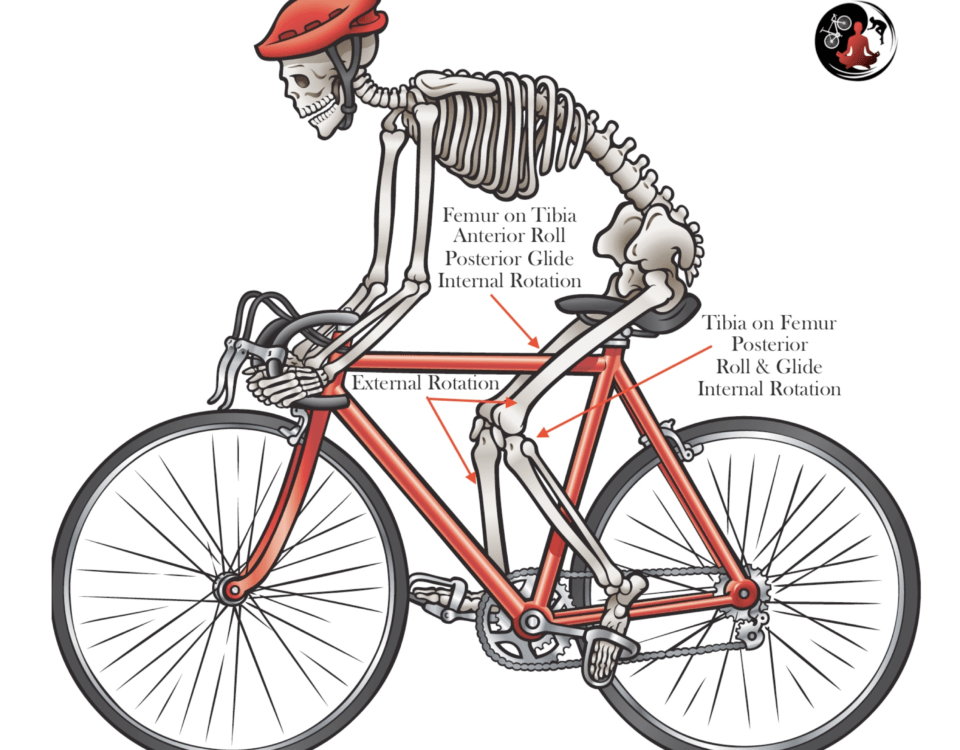
The Hyaline Cartilage of the Lateral Femoral Condyle provides smooth function within a limited Range of Motion.
Riding a saddle that is too low increases friction (at the condyle), patellar compression, and muscle fatigue (excessive line of pull).
Peace,
Chris
In normal weight bearing, all of the metatarsal heads are in contact with the ground. On the bike things change, you are semi-weight bearing. The lower leg muscular contraction during dynamic conditions change the pressures.
If a ski boot is “too stiff” the foot can’t balance! The truth is, there are many designs when it comes to cycling shoes. If you can micro adjust your feet, you transfer that energy (up to ten times) to another part of the body. Wonder why some people have sore knees, hips, and lower back?
The foot is a weight bearing grasping organ, or better a truss system and the loads just from your pedaling style can have you in an ouch!
The foot is composed of 33 joints, 26 bones and has 3 structural arches. It is extremely complex!
During weight-bearing, the arches serve as shock absorbers, dissipating energy before it is transferred across the ankle joint and to the shank, then upwards.
As in skiing, to tighten the system too much can cause you problems in other areas i.e. sore knees. In most cases, you want the arch to absorb the noise of riding a bike.
This is exactly why we take a podogram, which is a imprint of the weight bearing foot not unlike a fingerprint.
You can have the best golf swing in the world, but if you can’t get the club on the ball…, good luck.
From the Wobble-Naught Blog of Tom Coleman
Wobble-Naught Precision Fit Race Results
Kate Bevilaqua — WN’s Ironman Australia Champion 2010!
OMG!! I can’t believe I get to write that as the title of my blog! It is only really starting to sink in although it has been 3 days since the race.
Where to begin……?
On Wed, Dec 8, 2010 at 9:09 PM, Kate Bevilaqua wrote:
Thank you for your WN support!
Last weekend was a dream come true and I am so excited to finally be able to call myself an Ironman Champion. I have attached my race report and photo’s from the weekend.
Looking forward to a very exciting 2011
Enjoy you Xmas break! I definitely will be!
Kate Bevilaqua
www.katebevilaqua.com
Posted by WN at 6:35 AM 0 comments
Wednesday, December 08, 2010
Tim Butler (WN) Sue Butler’s husband takes WN!
Can we say the Butler’s haul butt?
Tim Butler is the husband of Sue Butler and he takes the WN on Sat!
He is 45+ USGP WN Fast!!!
Tim Butler wins the USGP Portland Day 1 and takes 3rd at Day 2 and 3rd USGP overall.
Sue Butler takes 3rd at the USGP Portland Day 1 and 7th at Day 2, Women Elite
No Butt’s about it, Butler’s are WN Fast!
Posted by WN at 2:54 PM 0 comments
Tuesday, December 07, 2010
Shonny Vanlandingham is XTERRA 2010 World Pro Champ!
Shonny is not one to just call us and tell us the news!
She is perhaps the Queen Of Modest!
We told her that she would be the best and she can back that up with her
XTERRA WN
2010 XTERRA World Championship
2010 – Makena Beach & Golf Resort, Maui
WN Precision athlete, Shonny Vanlandingham, wins the title.
Women’s Division Results
Place Name Swim Bike Run Overall Pro === 1 Shonny Vanlandingham #65 WN :24:20 01:42:40 00:51:20 2:58:20 2 Julie Dibens #61 :20:10 01:47:49 00:51:33 2:59:32 3 Marion Lorblanchet #66 :20:45 01:56:47 00:48:39 3:06:11 4 Christine Jeffrey #68 :19:41 01:55:48 00:51:53 3:07:22 5 Suzie Snyder #84 :21:39 01:53:05 00:53:20 3:08:04 6 Carina Wasle #64 :25:03 01:54:05 00:48:58 3:08:06 7 Lesley Paterson #62 :22:36 01:56:33 00:52:28 3:11:37 8 Sara Tarkington #69 :23:40 01:55:56 00:52:09 3:11:45 9 Emma Ruth Smith #83 :23:49 01:54:13 00:53:51 3:11:53 10 Emma Garrard #70 :23:04 01:53:39 00:56:55 3:13:38 11 Melanie McQuaid #63 :21:37 01:51:59 01:01:53 3:15:29 12 Danelle Kabush #67 :25:11 01:58:02 00:53:00 3:16:13 13 Mieko Carey #75 :23:08 02:00:58 00:57:05 3:21:11 14 Marie-Helene Premont #71 :31:11 02:01:38 00:57:27 3:30:16 15 Darelle Parker #81 :24:57 02:07:36 01:00:56 3:33:29 16 Katie Ellis #77 :22:42 02:12:58 00:58:20 3:34:00 17 Kristy Lanier #78 :26:45 02:05:56 01:01:44 3:34:25 18 Sabrina Enaux #73 :31:42 01:58:17 01:10:04 3:40:03 19 Daniela Machado #79 :28:01 02:19:05 01:13:52 4:00:58 20 Isabella Ribeiro #82 :31:24 02:37:15 01:14:47 4:23:26
Posted by WN at 6:40 AM 0 comments
Monday, December 06, 2010
Georgia Gould takes USGP Series!
Gould wins USGP series!
An official ringing the official bell for the final lap.
Czech champion Katerina Nash kind of course the USGP Portland Cup by putting in a error-free ride to claim her sixth career victory there on Sunday.
Nash virtually led a Luna team podium sweep, beating USGP series winner Georgia Gould, while Amy Dombroski claimed the third spot with a sizable margin over the rest of the field.
“I didn’t quite get the hole shot, I was second or third place, but I moved up to the front and wanted to make it a hard pace,” said Nash. “Georgia was always close, so there was always the concern about not making mistakes, pushing the pace and accelerating out of corners.”
Visit cyclingdirt.org for more Videos
Posted by WN at 1:17 PM 0 comments
Saturday, December 04, 2010
USGP CX Portland – Nash 1st, Georgia Gould (WN) 2nd, Sue Butler (WN) 3rd!
It was Georgia Gould (WN)who took off and teammate Nash on her wheel. They put time into the field from the gun. It then became a race only for Georgia to get tape in her rear gear, not able to shift, Nash put a gap on her. Soon after Gould made it back to Nash and made a pass. At the very end, Nash attacked back just before the last barriers took a wheel and had a very short lead for the win.
Sue Butler (WN) put on a show as she took 3rd in her home town. She road away from her rivals solo.
We think that Amanda Carey (WN) takes 10th.
1 Katerina Nash (Cze) Luna Pro Team
2 Georgia Gould (USA) Luna Pro Team
3 Susan Butler (USA) Hudz-Subaru
4 Linnea Coons (USA) Embrocation Cycling Journal
5 Meredith Miller (USA) California Giant-Specialized
6 Kaitlin Antonneau (USA) Cannondale-Cyclocrossworld.com
7 Katy Curtis (Can) CMC/Bow Cycle
8 Katherine Sherwin (USA) Hudz-Subaru
9 Wendy Simms (Can) Kona
10 Amanda Carey (USA) Kenda/Felt
Posted by WN at 3:37 PM 0 comments
Friday, December 03, 2010
2010 USGP Finale in Portland, OR. Will Gould take series?
Go to www.cyclingdirt.org and watch live!!!
The conditions are a perfect for the huge weekend of cross! WN has three gals to keep an eye on, Georgia Gould, Sue Butler, Amanda Carey.
The Finale. Where better to finish up the USGP season than in Portland, OR – home to some of the top athletes in the sport and always epic conditions. We’ve raced in hurricanes, freezing fog, brilliant sunshine and torrential rain – often on the same day! But if we know one thing it’s this – Sunday brings out the best in everybody. Year in and year out, Portland offers up the crowds of afficianados the conditions and level of racing that people expect from the sport of ‘cross and provides a true test to the amateur and pro athlete alike. This year, the USA Cycling Cyclocross National Championships are in Bend one week following Portland – we can already feel the excitement building for the biggest weekend of ‘cross we’ve seen to date.
On the women’s side, Georgia Gould (WN Luna) looks like a safe bet to take home her 2nd career USGP title. The Luna rider leads Katie Compton by 58 points, but the US champion Compton will be taking the weekend off to rest up for her title defence. In third, Meredith Miller is a distant 79 points behind, and as long as Gould stays in the top 10 her series win will be secure.
Posted by WN at 3:19 PM 0 comments
Saturday, November 27, 2010
Amanda Carey (WN/Kenda) NUE Series Champ can CX! She gets 5th at Jingle CX.
Is there any question that Amanda’s focus was racing a 100 mile mtb race for 8 plus hours. It’s very different than a sprint of less than 45 min cx.
Amanda (WN/Kenda Pro) is getting her sea legs or was that land legs or better, cx legs? Perhaps she will be in the hunt at USGP in Portland, OR.
The Kenda mtb pro is a good story!
1. Meredith Miller, California Giant Berry Farms/sp,
2. Nicole Duke, Hudz-Subaru Cycling Team,
3. Amanda Miller, Hudz-Subaru Cycling Team,
4. Kaitlin Antonneau, Team Kenda,
5. Amanda Carey (WN),
Posted by WN at 9:12 AM 0 comments
Friday, November 26, 2010
Sue Butler – takes OBRA CX Championships
“A picture tells a thousand words, but you have to know what you are talking about”
In case you were not impressed by my former posting:
Wobble-Naught Bike Fitting
WN is the scientific solution for Bike Fit. The CAD system uses laser-precise measurements to blueprint the optimal line of pull and ROM for every muscle and joint when cycling. There are numerous models available for bipedal activities, but none more sophisticated and important to the bike-fitting industry.
Why?
Each muscle fires effectively within the constraints of a specific length, and range of motion. More, or less, can produce fatigue, injury, and weakness. Using the best muscles for cycling ensures better blood-flow and oxygen utilization, which means you’ll go faster and be stronger, longer, with greater comfort and ease.
How?
Tom employs electrical, biomechanical, kinematic, and software professionals, who understand cycling and appreciate the importance of specificity when it comes to bike fit. WN is built on a decade of research and examination, using the industry’s best telemetric-EMG’s, sensor plate technology, 3D-virtual anatomical and simulation software and athletes.
It is the only fit-system I’ve seen that addresses human variability with regards to individual force-vector limitations, muscle firing sequences, joint-types and bone morphology, internally.
Does it work?
You-bet-cha!
I watched a rider show a 30-50 watt increase in the WN studio after fitting. And this was not a fluke, either. Tom had me speak with at least five, national and world champions during my visit, to confirm similar outcomes.
Each credited the WN system for his/her success.
Peace.
The Bicycle Fitting industry is very different from when I started in the late 80′s. All the “pros” used ”Fit Kit”(still a great product) — the non computerized version — and modifying insoles or shimming shoes/pedals was appropriate only for the infirm and/or injured.
Today we employ a number of different systems and tools, each marketed as superior to the next — all necessary to get the jobe done. The promise is to reduce error and increase utility, making it possible for anyone who completes a short training to employ with “Professional” status.
I am clearly not a fan. The human condition is too variable to be harnessed by a singular application — 2D, 3D, 2D x 2D (3D?), or otherwise.
Technology is a great aid, but a poor substitute for the knowledge, experience and humility. Why humility? Because adjustments are only good when the inverse is equally bad. Each hypothesis requres testing to ensure confidence. Sometimes this testing uncovers a solution discovered exactly opposite the “standard-protocal”. Clearly, my Ego is not my amigo.
Another problem is specificity. Most of us rely on physical therapy techniques to evaluate leg-length, varus/valgus foot, hamstrings, psoas, illiotibial bands, flexibility, etc. I am happy to provide alternate, cycling-specific tests, but only if you pay . Just kidding.
Here is an example of the standard leg-length test and alternate hypotheses:
Measuring LLD — actual or apparent.
Full Leg:
Tonic QL or scarring or scoliosis = false positive for short leg.
Excessive facet mobility= false long leg on injured side.
Schmorl’s nodes = false as related to r/l endplates
Pelvic Fixation = false short on anterior side.
Femoral:
Much the same as above, but also with illiofemoral ligament..
Tibial:
R/L arch height variation @.08 population, indicating long/short; high/low
How do I measure for LLD? Cyclist on bike, saddle raised to maximum possible pedaling, I observe hip rotation, terminal extension and vertebral translation. If the left hip reaches further, it is possible that the left leg is short, but only if the spine follows. Sometimes the leg appears short due to increased contra-lateral muscle mass (QL, ES, etc.), scoliosis, pelvic rotation, etc. Fortunately, all of these issues are easily observed from behind the rider. Seems more accurate than laying on a massage table and having your legs tugged?
The notion that an application can make anyone a fit-professional is anologus to a machine subsitute for someone like Richard Sachs.
That being said, I love the gadgets that make my job easier.
Check the “Technology” tab for more information.
There is a big difference between the Triathlon and Time-Trial bike fit.
The most obvious difference is that at the end of a Time Trial the rider should be completely spent; at the end of the Triathlon bike-split, the rider needs to run as fast as possible to the finish, sometimes to the tune of 26.2 miles.
No triathlete has ever won an event by his/her bike time, so it makes sense to fit a person for the best transition into running as possible. This usually entails having the seat forward, increasing hip-angle for transition to running and better aerodynamics via. lower front-end. Elbows should rest under shoulders (approximately), with enough distance between arm-pads to ensure optimal diaphragm function and comfort. Most top-fitters will suggest a more relaxed position over aerodynamics for Triathletes.
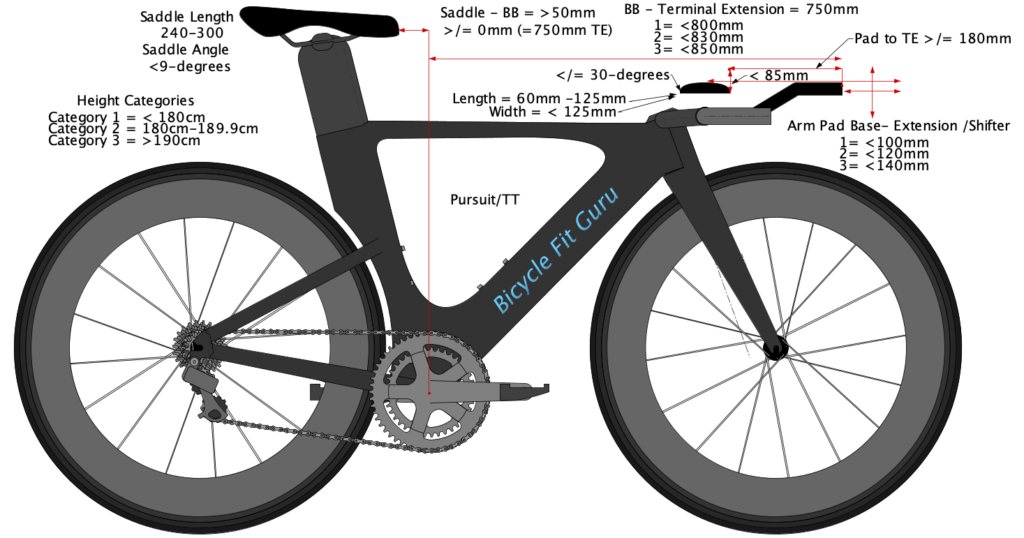
Time-trialists are UCI- restricted to position the saddle nose 5cm behind the bottom bracket (though most proficient racers ride the nose, anyway). This creates a problem at the hip-angle (significantly reduced) that impacts the rider’s ability to increase saddle to bar differential, which many consider essential to optimize aerodynamics. The fit is speed-specific, tuned to maximize aerodynamics and power for a specific distance/terrain/condition. Elbows are closer and anterior to shoulders, back is more kyphotic, and diaphragm position is altered to breath from the thoracic/lumbar junction.
Hip Angles:
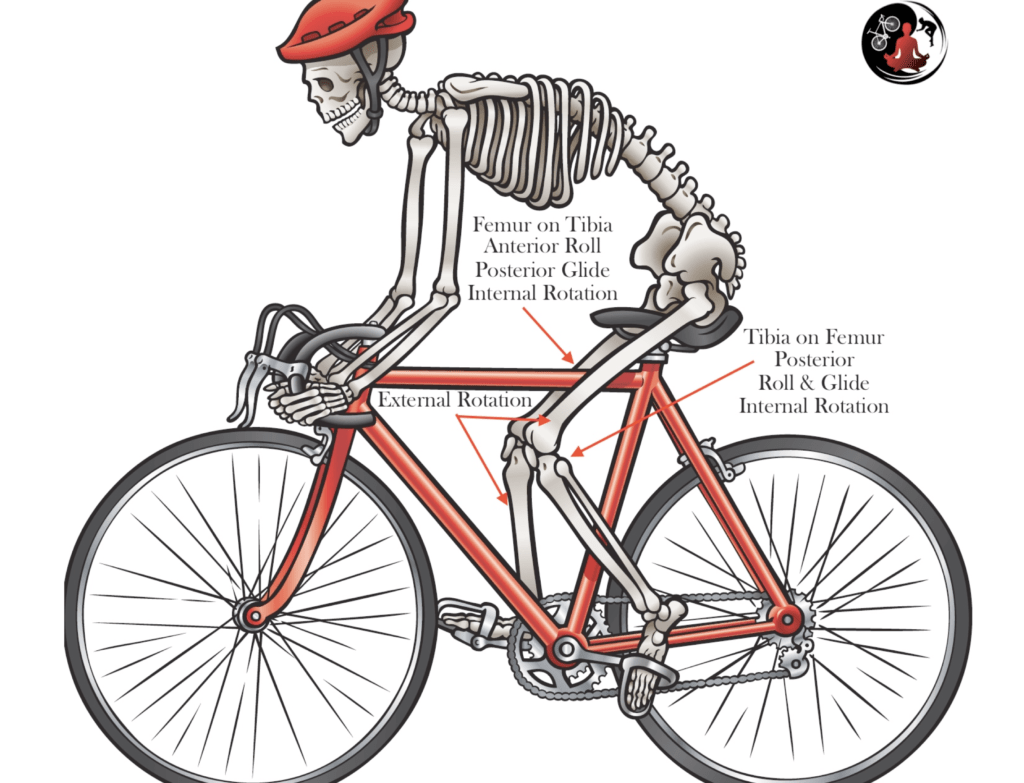
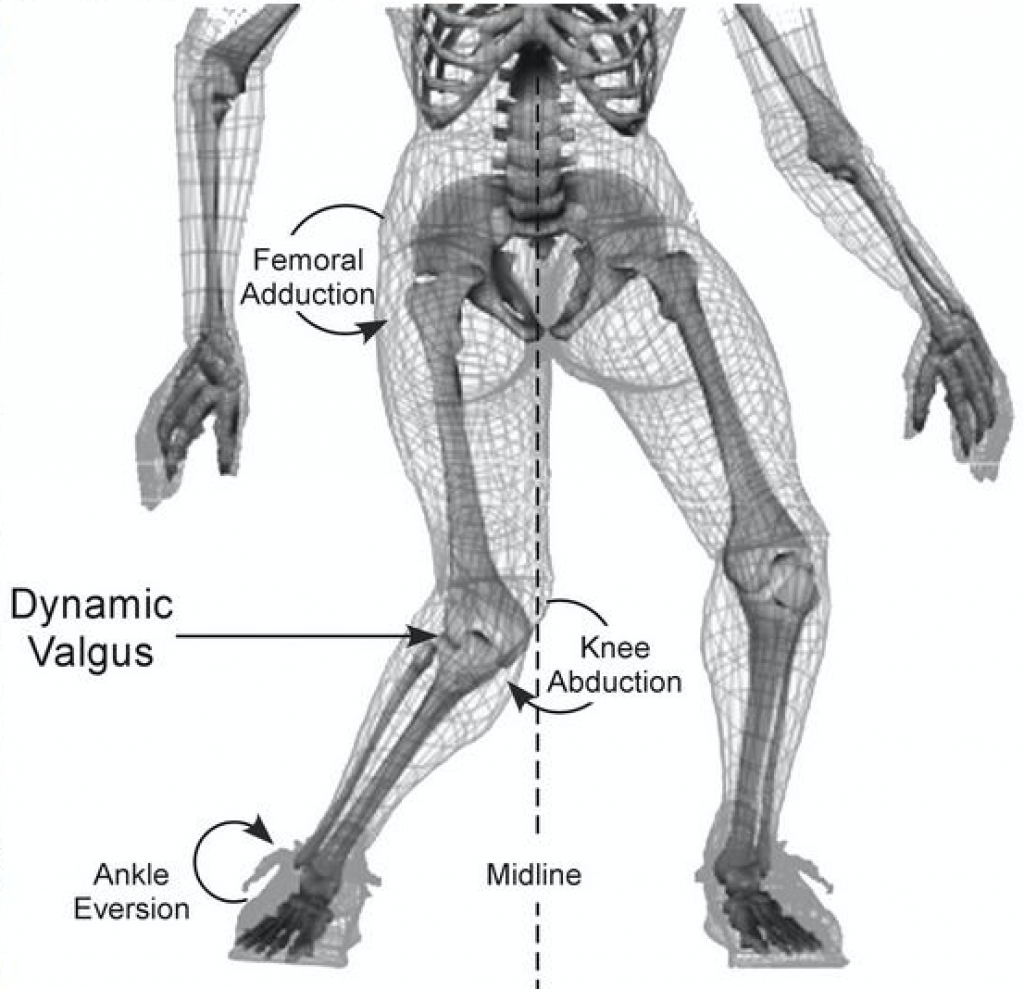
Most TT and Tri customers I meet are positioned with femoral/inferior iliac crest contact at TDC, and ”head-up” posture. Easier to fix for the Triathlete than the TT person, obviously. The problem is that compression between pelvis and thigh is hardly perceptible, like pinching the skin at your elbow — neurologically, just not very proprioceptive. Symptoms can occur at the acetabulum, unilateral or bilateral back, medial or lateral knee . Want to check if this applies to your position? Have someone place a finger at the crease of your hip, and see if it gets crushed by the femur at TDC. Also check knee position at TDC. Splayed knees may add confidence to your findings if positive for the finger-crush-test (rule-out psoas). The leg has to go somewhere at TDC, and lateral is the only option if restricted by hip angle.
Additionally, the diaphragm shares attachments of the quadratus lumborum (low back) muscles. It makes sense, anatomically, that tight QL’s = lesser exhalation = shallow breathing = poor O2 intake = bad performance.
Head-Up vs. Head-Down?
Aerodynamics:
Tom Coleman has a picture of a fish on his computer screen, to remind him about aerodynamics. Fish are aerodynamic — humans, not so much. Our face is like a wall, creating drrrrraaaaaagggg; conversely, Head-Down with a traditional cycling helmet (with big holes) is also creating drrrrrraaaaaaggggg — like a plane, landing. Wind tunnel testing indicates Head-Down with an aero helmet is the best option.
Musculoskeletal Function:
Try this:
Bend your knees, feet hip-distance, and place hands, approximate to knees, on your thighs. Shift your gaze and face to horizontal, and take a really deep breath. Feel good? Now, do the same exercise, but with head “neutral”, and gaze at the horizon of your eyelids. Get it?
In closing, remember that it is a fine line between aerodynamics and performance. A quality fit-technician should know how to optimize both, specific to the DNA of each cyclist.
A large portion of my business comes from female/petite cyclists. Not because I am “Macho”, but because I understand the differences/and misconceptions between Male and Female anatomy. More importantly, I recognize that most women’s product is designed and manufactured by men, thinking within the context of being a man.
I remember one of my first phone-calls to Speedplay, about making shorter spindles for petite cyclists:
Me:
“Hi. My name is Chris Balser, and I am a bike fitter located in Minneapolis, MN, looking for a pedal solution for petite cyclists.”
Customer Service:
“For what?”
Me:
“Petite Cyclist!” ”Have you ever seen the pedal to pedal distance (q-factor) for a person that weighs under 100 lbs?” ”It looks like they are riding a horse!” ”This position impacts the force trajectory from femur-head to foot, robbing power and creating tension at hip/knee/ankle joints.” ”Why don’t you guys make a shorter spindle-option?”
Customer Service:
“Because, if we did, your shoe would hit the crank-arm.”
If I have to explain why his response makes no sense, stop reading – this post is for women.
For the rest of you, I recently came across a sweet website — www.petitebikefit.com — that I strongly recommend reviewing for smaller cyclists.
Yes, the industry is slowly moving towards addressing the needs of smaller/thinner/petite cyclists, but quality 36cm handlebars, narrow cranks, short spindle pedals, shifter mods, and < 51 cm top-tubes are difficult to find. The petitebikefit website provides some great information regarding things to look for, product availability, and comparative specifications.
Peace,
Chris
Here is the scoop on leg-length discrepancy:
1. The only accurate way to determine actual bone-length LLD is midline-measurment on x-ray film. This measure does not indicate effective LLD.
2. The only accurate way to determine actual greater trochanter to calcaneus LLD (effective) is vertical axis measurement on x-ray film
3. Pelvic angles alter effective leg-length. Anterior illlium roation = shorter leg; Posterior, longer leg. You can examine this principle by tilting and tucking your entire pelvis.
4. Arch height alters effective leg-length. Higher/ hard arch = longer leg; Lower/softer arch = shorter leg.
5. Heel drop alters effective leg–length. Achilles tendon tears, hamstring tears = lesser or greater extension to pedal. Heel drop= shorter; toe point = longer. Rule-out heel drop differences to accomodate actual LLD.
6. Spine curvature alters effective leg-length. Right translated spine = short left leg; left translated spine = short right leg. Rule-out actual LLD causing spine translation (longer left leg forcing left hip, up, and spine, right, etc.). Right rotated spine = long right leg; left rotated spine = long left leg (unless caused by femoral LLD or countered by opposing rotation).
7. Unequal arm length, golf, unilateral breathing (swimming), tennis, etc., can all contribute to effective LLD’s for cyclists.
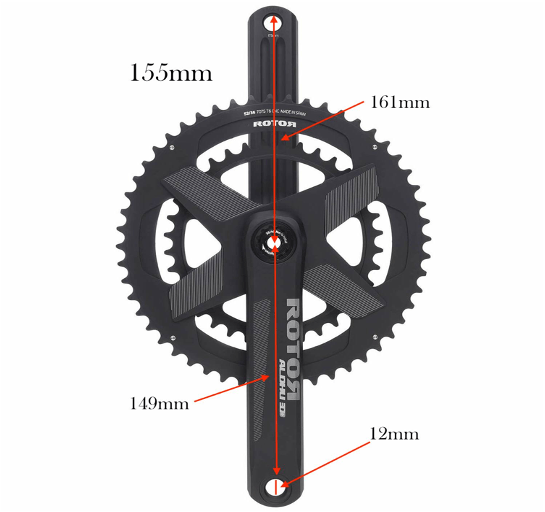
8. Tibial LLD is altered by vertical correction; Femoral LLD requires horozontal correction with greater emphasis on 3pm and 9pm and less at 12pm and 6pm. There are a few crank builders who manufacturer cranks specific to the latter requirements.
9. Not all LLD’s require correction.
10. Symptoms that suggest a visit to your local bicycle fit guru-guy: Unilateral back pain, unilateral knee pain, strong weight imbalance between arms; unilateral saddle positioning (sitting off to one side (barring saddle sore)), riding in a “wind-swept” position (one knee close to the top-tube, the other far from the top-tube), etc.
Most LLD’s are easily corrected by a good fitter with the right tools.
Chris
Professional Bicycle Fitting Precautions
A Consumer’s Guide
An increasing number of bicycle dealers are now offering “professional fit” services”, and with fees ranging from $30-$400+, it is useful to have some facts before making an appointment — if an appointment is really what you need.
1. The majority of “Bicycle Fit Professionals” have attended a total of only 3-7 days training. Ask for credentials and references, and employ internet search-engines for unbiased data.
2. Systematic protocol is flawed by negating the diversity between cyclists. Humans are too unique and complex for patent assessments and and/or outcome data. If an adjustment causes discomfort, it is wrong for your body.
3. Video analysis is two-dimensional, regardless of how many cameras are used. 3D motion analysis is subject to LED placement variability. These tools are good at recording angles. Creating optimal fit is the responsibility of you and your technician.
4. Saddle Height is not static. To demonstrate, bend forward and try to touch the floor. Do it again. Try repeating the exercise when it is cold, hot, at the end of a hard ride, before an easy ride, etc. It will never be identical because our activities and climate are always changing. Remember this when prescribed the “magic number”.
5. Good bike fit does not hurt! If you continue to have pain anywhere that is not a function of fatigue, your fit can be improved
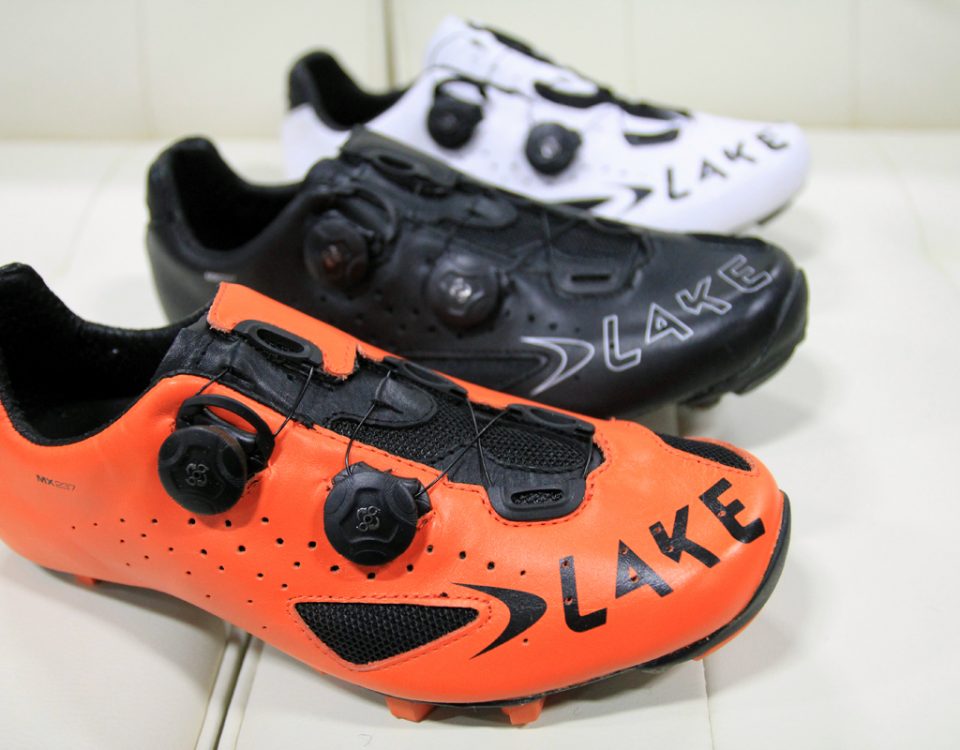
6. Shoes should be comfortable. Do not believe that they will “break-in”. They must not be loose, either. A good fit technician can modify shoe-fit with shoe-maker and podiatry tooling.
7. Assessment procedures based on physical therapy techniques are not reliable for outcome data. There is an inherent flaw to every test due to bone and ligament variability. So if you are told you have: “X”, “Y”, or “Z”, get it confirmed by a doctor before announcing it to the world.
8. It is not hard to find a comfortable saddle. It is very hard to find someone willing to put your bike on a stand and let you try a number of makes and models. Do not expect it to break-in. It is your fitter’s responsibility to determine proper sizing.
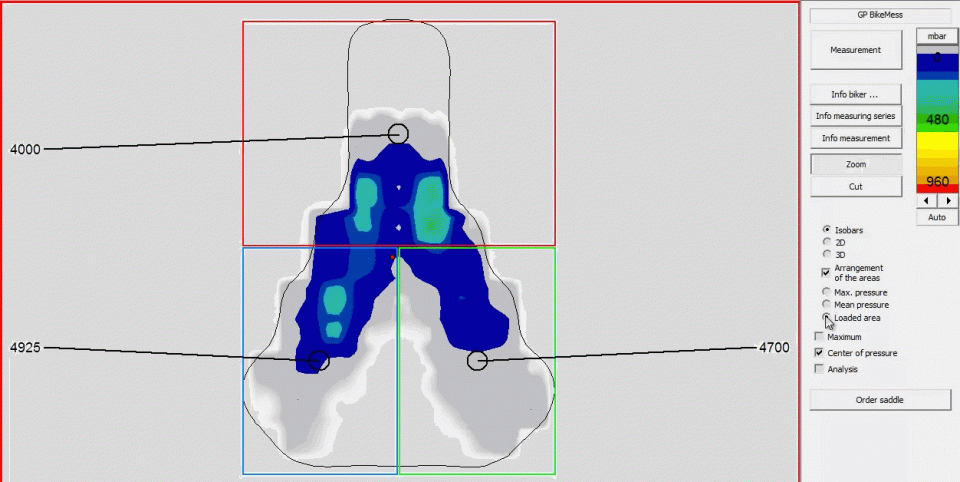
9. Sit-bone measurement devices have no utility when determining correct saddle-size. Saddle comfort is a product of pressure distribution and pelvic stability. The correct saddle for you will have a nose-width, taper, and terminal shape consistent with pubis, rami, tuberosities, and functional pelvic angle.
10. You are the true authority on bike fit for your body. The most accurate union for you and your bike resides inside YOU! The nervous system components, proprioception (feedback mechanism for body movement); vestibular sense (balance in relation to movement and gravity); and kinesthesia (joint position) are sufficient to the task, but are primarily “touchy-feely”. They are great at determining what is better and worse on a bike, but are unable to sample different options due to the nature of cycling.
Our problem is that riding a bicycle is unnatural. We were not intended to be stuck in a fixed, symmetrical position, making circles with our feet, suspended by saddle and handlebars. Our data for negotiating life is built from the knowledge, experience, and practice of events. Learning involves practice; practice increases knowledge, and time creates experience.
Look for my article on “tips and tricks to bike fit” in the blog section of my website, early September, 1009.
Namaste.

OAKDALE DUATHLON Lake Elmo, Oakdale, May 12th, 2012 3 Mile Run - … [Read More...]
Copyright © 2012 · Genesis Framework by StudioPress · WordPress · Log in